For maintenance facilities

Turn wrenches,not pages.

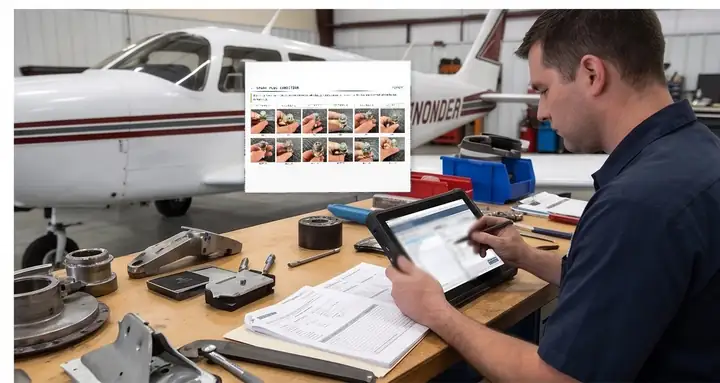
Built by a working A&P to keep you out of the office. SquawkShop takes the guesswork out of your AD research, covers your tail on pre-existing damage to the customer’s tail, and gets the owner’s work authorization in writing—all before you even pick up a wrench. Every squawk and photo you log at the wing instantly builds your reports, logbook entries, and invoices. Do it once on the floor. Go home on time. Never at midnight.

Built by a working A&P. Used on real inspections before it was sold to anyone.

SquawkShop
In the hangar

The inspection

Two hundred checklist items, squawks, photos and AD compliance on the tablet in your hand. It runs with the airplane between you and the nearest bar of signal, because a hangar is not an office.

On his phone

The owner's page

Your logo, your color, one link that never changes. He sees exactly what you chose to show him, and approves extra work himself — so the airplane is not sitting while you trade voicemails.
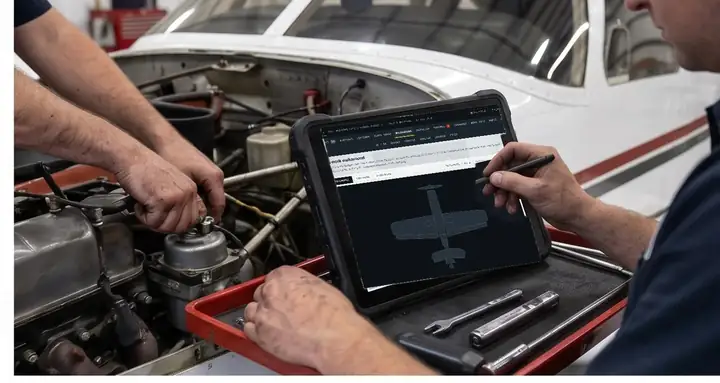
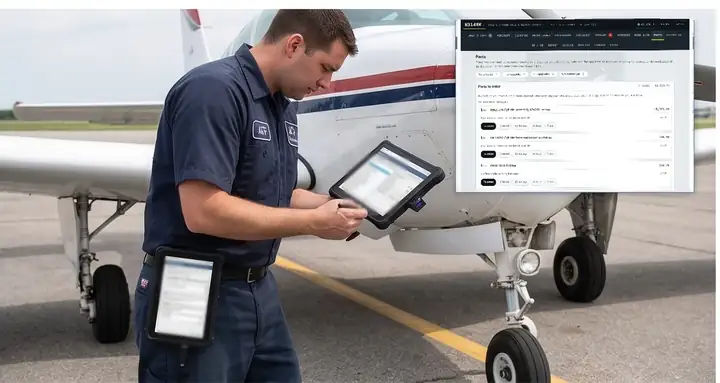
No wifi, no office, no problem!
One tool that works for you
Recorded in real time
How it works

Four stages, in the order a job actually happens.

01

Arrive

Walk the airplane and record the condition it turned up in. Take down the owner's own squawks in his words, so they cannot quietly disappear.

02

Inspect

Work the checklist. Raise findings with photographs as you hit them. Record AD and service bulletin compliance. None of it needs a connection.

03

Get the answer

Extra work goes to the owner as a written authorization request with hours and dollars on every line, on his phone. However he answers — text, email or a phone call — what he said goes on the record with it.

04

Close it out

The invoice, the inspection report and the logbook entries are already built out of the work you recorded. You sign; you do not start writing.

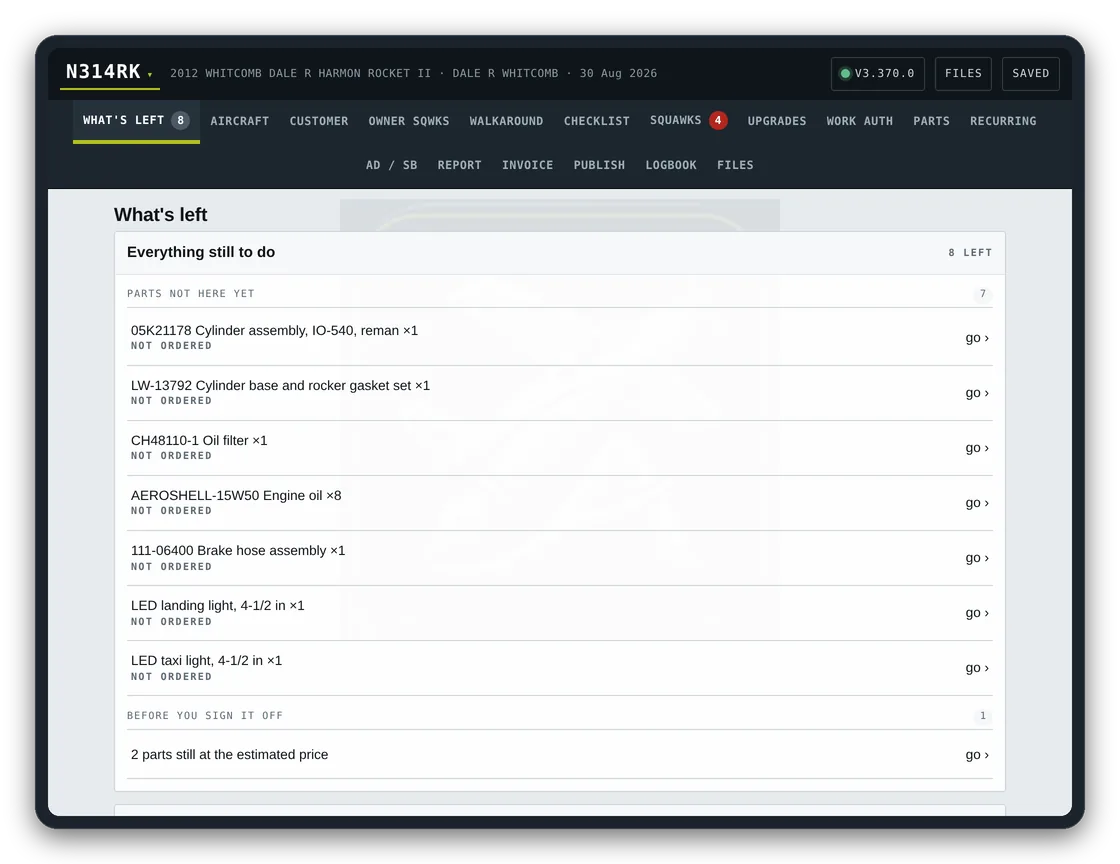
What is still to do on the job, on the tablet.
Where it came from

Written in a maintenance shop, not in a software company.

Every checklist item, form field, and edge case is here because a real aircraft on a real ramp demanded it. If a feature sounds oddly specific, that’s why.

We ran this on paying annuals for a full year before offering it to anyone. There are no theoretical mock-ups here. It is an everyday tool built to optimize your workflow — streamlining the paperwork so you can turn aircraft around quicker, raise your quality of work, and give the customer a better experience.

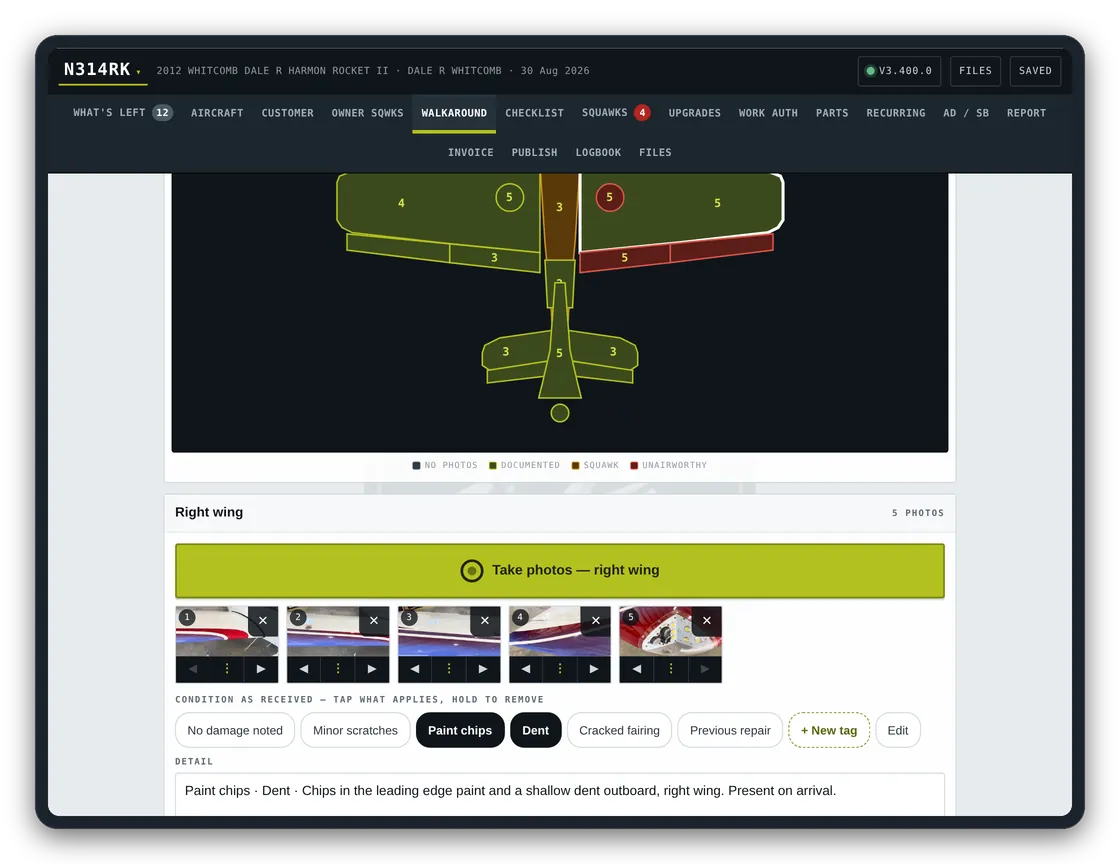
The pre-work walkaround, before a tool comes out.
Before a tool comes out

Don’t buy their hangar rash.

Damage that was already there. A finding the owner does not believe. A number he first hears when the bill lands. None of those are mechanical problems, and all three are cheaper to prevent than to argue about.

Lock in the condition it arrived in

Tap a zone on the aircraft diagram, snap a photo, and lock in the exact condition the aircraft arrived in — dents, scrapes, paint, glass, tires, interior. Three weeks later, when an owner is certain the hangar rash on his flap happened on your floor, you are not arguing from memory. You have a dated record of what he handed you. Fifteen minutes, and it is the cheapest insurance in the building.

A checklist that will not let you skip a step

Over two hundred items in the order you actually work them, each one showing checked, squawked, or not yet reached. You get pulled onto another airplane for two hours and come back knowing exactly where you stopped. Nothing gets missed because you were sure you had already done it.

And it can be your checklist, not ours. Bring in your own from a spreadsheet — drop in the .xlsx, or paste the rows — and name it after the type. Your groups, your wording, your intervals, and a box for anything that gets written down rather than ticked. It shows you exactly what it read before it changes a thing on the tablet, then keeps it and offers it on the next aircraft of that type. Every shop has a list that took twenty years to write. This one finally fits.

Address every complaint in writing

Log the owner’s complaints while you are still on the phone, or let him write them up himself on his own link — before the airplane arrives, and again while it is on the floor. It lands in your job as his squawk, in his words, in the same list as your own findings, and the report and the logbook entry both stop and name any one you have not answered before they will build. Nothing to dig out of a mail thread, nothing to forget at four on a Friday. The fastest way to lose a customer is to hand back an airplane with a fresh inspection and the one thing he complained about still doing it.

Owner squawks, the condition-on-arrival record, and a checklist that is yours.2:34 · narrated
The conversation that costs you money

End the sticker shock.

Owners get defensive when they hear about a squawk. They cannot argue with what they can see. The counter is where an annual turns into an argument, and it does not have to be the first time he sees the number.

He can see the crack for himself

An owner hears the number five exhaust gasket is corroded and hears a bill. He has never seen the gasket. Photograph the finding and the photograph travels with it onto his page, printed under the sentence describing it. Most resistance to a repair is disbelief, and disbelief does not survive a picture.

The price is settled while it is still on jacks

Additional squawks found during the inspection that you never quoted go to the customer as a work authorization request — every line with the hours, the parts and the dollar amount, and whether it is an airworthiness item or a deferrable one, so he knows which ones are genuinely his choice. He proceeds or he defers, and he is in the decision instead of hearing about it afterwards. Record his authorization however it comes — a text, an email, a phone call. What you record is what he actually said — the method, the date, the name, the not-to-exceed figure he gave you, and a screenshot of his reply attached to the file. No end-of-annual sticker shock, and no argument later about what was agreed.

Progress he can watch instead of ask about

One private link, live, showing how far through the checklist you are and what you have found so far. He stops calling to ask how it is going because he can already see how it is going. You decide what appears on it, line by line, and what you leave unticked never leaves the tablet.

The link the owner opens — findings, plug and borescope photographs, and the price.2:20 · narrated
The work that gets left on the floor

The recommendation you never made is the cheapest revenue you will ever lose.

The recommendation you would have forgotten to make

A place for the work he did not know he could buy — the borescope program, the avionics, the interior — priced and photographed, on the same page he is already approving from. It is a great deal easier to say yes to something you can see than to something mentioned in passing at pickup.

Stop giving away parts for free

Parts leakage kills shop profitability. Every part on the job comes straight off your cleared squawks and approved upgrades, and carries a status — to order, ordered, shipped, on the shelf — so the dashboard shows your inventory in real time. You know what is holding the airplane and what the shelf is short of without opening a second spreadsheet.

And if a part comes in above what you quoted, you hear about it before the customer does. You set the threshold — more than fifty dollars, or more than fifteen percent, whichever you would want to know about — and anything over it is flagged so you can adjust the work authorization while the airplane is still on jacks, instead of absorbing it on the final invoice.

Estimates against actuals

The invoice reads Estimated 8 hr / actual 5 hr — $330.00 below estimate, so a job that came in under is visible instead of invisible. Tax is charged on goods and freight only, never on handling, so the line matches the supplier receipt dollar for dollar.

Recommendations, the parts list, overages, and estimate against actual.2:30 · narrated
The part nobody became a mechanic for

Sign it off and go home.

You did not get your ticket to sit at a desk. The wrenching finishes and the writing starts, and that second job is the one this was built to delete — because the checks, the parts and the cleared squawks were captured while you worked.

The § 43.9 logbook block is already written

Part 43 compliant logbook entries, generated for you. The entry is built from the corrective actions you typed when you did the work — your words, not keywords fed through a template. By the time the cowling is back on, it is sitting there waiting on your signature. Print it, sign it, hand over the keys. You are not at the desk at seven at night trying to remember what you did to the left brake.

The report and the invoice build themselves

Close the inspection and the full conditional report and the itemized invoice are already there, made out of the same findings and hours you entered at the airplane. Nothing is retyped from a legal pad, so nothing gets retyped wrong.

Documents that are the real thing

The report, the invoice and the authorization request are the documents that print — photographs embedded, page breaks intact, your letterhead on top. What the owner downloads is what you would have handed him across the counter, not a thinned-out web version of it.

Your name on it, not ours

The owner's page carries your logo, your color and your phone number. The one thing your branding cannot touch is the airworthiness colors — a shop can brand the page, but it does not get to make an unairworthy finding look like good news.

The report, the logbook entry and the invoice, out of one pass.2:45 · narrated
The AD problem

The AD problem, finally solved.

An AD search on a 1970s airframe should not take all day.

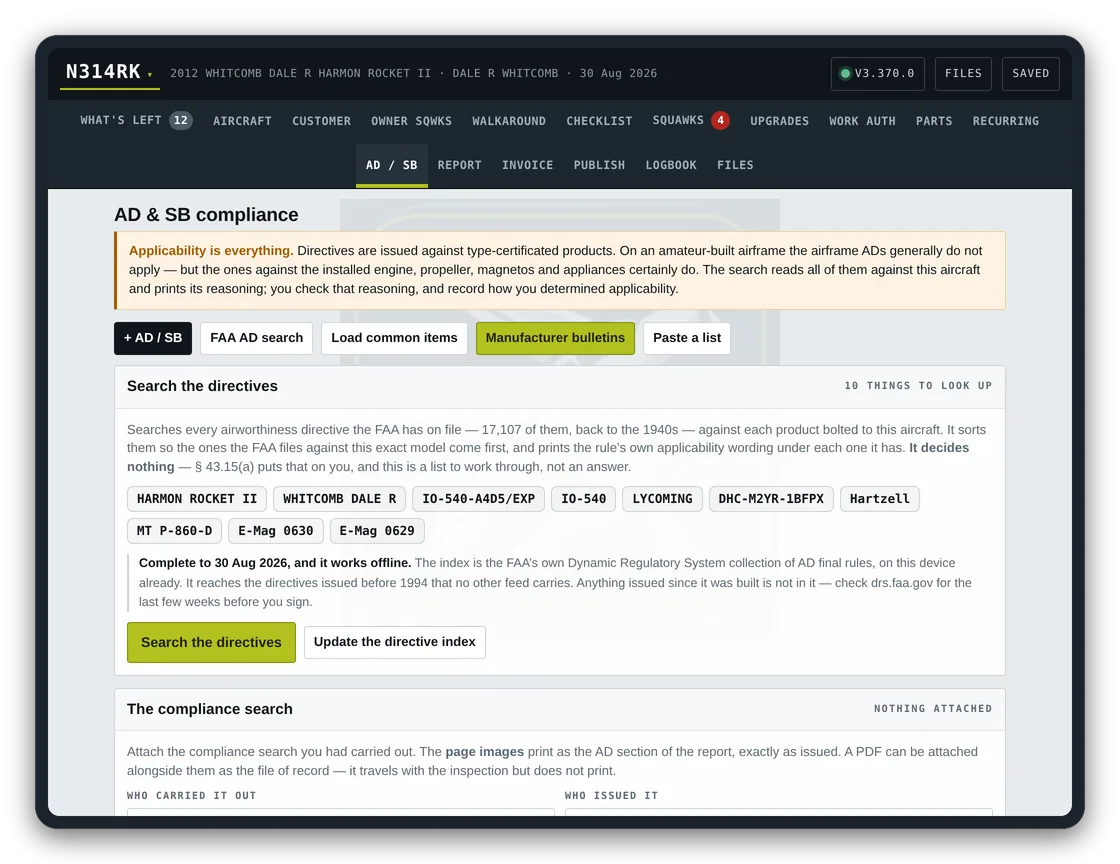
The FAA has 17,107 live airworthiness directives. 6,610 of them were issued before 1994, and no machine-readable feed carries a single one. On an aircraft built in the seventies that is not an edge case — it is two rules in every five, and they are still live. Most software hands you a wall of text and wishes you luck.

So SquawkShop does not read a feed. It carries the FAA’s own library — every directive on file, with the applicability paragraph the agency actually wrote — as a file on the tablet.

693

The FAA’s own answer

Directives its model search returns across 23 aircraft types, a Cessna 150 through an Aerostar 601P.

693

What SquawkShop found

All of them. Model by model — not a total that happens to agree.

0

Wrongly set aside

Nothing the FAA lists was filed away as not applicable to the aircraft.

Checked 30 August 2026 against the model search at drs.faa.gov — the FAA’s own database, free and public. Nothing stops you running the same check on your own aircraft, and we would rather you did.

  • Equipment matched to the aircraft, not to a list you cross-reference by hand. A directive is issued against whatever part is defective — a magneto, a carburetor, a transponder. If the aircraft has the part, the rule is on your list, one line each, answered by looking at the aircraft rather than by memory.
  • No naked N/As. A blank “not applicable” in a logbook is a write-up waiting to happen. Everything set aside here prints the reason in the rule’s own words — “the rule names PA-28R-180, PA-28R-200 — not PA-28-181” — so you check the reasoning instead of trusting it.
  • Serial ranges are read, not skipped. A directive covering Model 172 serials 17261664 through 17261808 does not sit on your list when the aircraft in the hangar is 17262730.
  • It works at the far end of a gravel strip. A hangar is a metal box with bad wifi. The directive search makes no network request at all and returns in under a second, with no signal.
  • ×It is not a determination, and it never claims to be. § 43.15(a) puts that on the mechanic. What it does is put the paragraph in front of you instead of leaving you to find it.
Seventeen thousand directives read against one aircraft, offline.2:30 · narrated
The part shops ask about first

The tablet is the whole system. A connection is optional.

Every inspection app demos beautifully on office wifi. The question is what it does at the far end of a gravel strip, in a hangar with one bar and a hotspot that keeps dropping.

  • It installs on the tablet and opens with the wifi switched off. Not a website that caches a bit of itself — the whole app, the checklist and the PDF reader are on the device. There is no spinner, because there is nothing to wait for.
  • Every check, squawk, photograph and logbook entry is written to the tablet the moment you enter it. Not queued for a server to accept later. Written, immediately, where you can see it.
  • ×Two things need a connection, and that is the whole list: pulling an AD or service bulletin document down, and sending the owner his page. Work the entire inspection with no signal and publish from the truck on the way home.
  • Every job exports as a single file with the photographs inside it. Back it up to your own drive whenever you like. If you stop paying, or we go under, your work is a file you already have — no export request, no waiting on anybody.
  • Another shop cannot see your work, and that is enforced by the database rather than by the app being careful. Fifteen checks have to pass before anything ships.
Seventeen thousand directives, searched with no signal.
Who it is for

Small shops doing careful work.

A&Ps and IAs

One mechanic or a few. You do condition inspections and annuals, you write your own logbook entries, and you would rather spend the evening finishing the paperwork than rebuilding it.

Shops with owners who ring

If half your interruptions are "how is it coming along", the status page pays for itself in the first week. He looks; you keep working.

Experimental and vintage

Built first for a Harmon Rocket II. Service bulletin links, borescope images, data plates, and free-text where the world refuses to fit a dropdown.

Anywhere the signal is bad

Written for hangars where no bars is not an edge case. Offline is the normal state, not a fallback.

Pricing

Priced by how many people use it. Nothing else.

Every plan is the whole thing — offline inspections, the directive library, the owner’s page, reports, logbook entries and invoices. No charge per aircraft, none per inspection, and the owner is never charged to open the link you send him.

Solo

1 person

$75 /month

One certificate. Your own airplanes, your own logbook entries, nobody else in the file.

Shop

Up to 5 people

$195 /month

Two or three mechanics and whoever does the invoicing. This is where most shops land.

Multi

Up to 15 people

$395 /month

More than one bay, or more than one location working out of the same records.

Unlimited

Any number

$695 /month

Take on people without counting them. The price stops here and does not move again.

Taking on one more mechanic does not move you up a plan.

People over your plan’s count are $45 a month each. You are then billed whichever is cheaper — your plan plus those extras, or the next plan up. Growing never costs you more than the plan above would have.

6 people$240 a monthShop plus one, rather than a jump to $395
11 people$395 a monththe extras have passed Multi, so Multi it is
16 people$440 a monthMulti plus one
40 people$695 a monthUnlimited, and it stops there

Thirty days, no card

You get all of it for thirty days without typing a card number in. If you stop at the end of it, nothing is charged then and nothing is charged later.

Paying by the year costs the same

A year up front is twelve times the monthly price. There is no discount for it and no penalty either — it is there because some shops would rather cut one check a year than watch a charge go out every month.

Prices are US dollars and cover the shop, not the airplane. Change plan or stop at the end of any month.

Early access

Taking on the first shops now.

You get my phone number, not a ticket number.

SquawkShop runs a real shop today and is being fitted to the next few by hand. Start the thirty days yourself, or write to me first if you would rather hear whether it suits the work you do before you put a day into it. Either way you are talking to the mechanic who built it.